
Expert Raised Floor Engineering Q&A Series
Stringer systems are one of the most misunderstood components of a raised access floor. Contractors specify them, facility managers maintain them, and inspectors evaluate them — yet conversations about stringer choice, tolerances, and load behavior are often clouded by myths carried over from older installations. In this expert FAQ, we answer the questions we hear most often from procurement teams, junior specifiers, and field technicians.
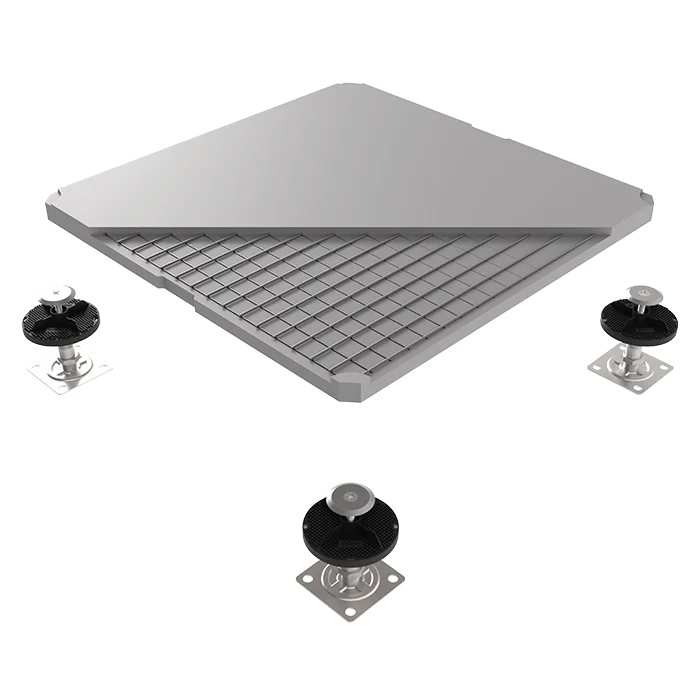
Figure 1. Pedestal and panel assembly showing stringer connection points.
Q1. What exactly does a stringer do in a raised floor system?
A stringer is a horizontal steel bar that connects the heads of adjacent pedestals, forming a rigid grid beneath the panels. Its primary job is lateral stability: it prevents pedestals from racking or tilting under dynamic load, and it distributes concentrated forces across multiple support points instead of letting them punch into a single pedestal head.
Without a stringer, panels rest only on individual pedestal caps. That works for light office traffic but becomes risky in environments with rolling loads, seismic activity, or rack-mounted equipment that exceeds 800 kg per cabinet.
Q2. Are stringers really necessary if my pedestals are glued and bolted?
Adhesive and base-plate fasteners only secure the bottom of the pedestal to the slab. They do nothing to stabilize the top of the pedestal, which is where panel deflection and lateral movement actually occur.
A bolted stringer ties the upper section of every pedestal into a continuous frame, dramatically reducing horizontal sway. In data centers, hospitals, and lab environments, this is not optional — it is what makes the floor "concurrently maintainable" when individual panels are lifted.
Q3. What's the difference between bolted and snap-on stringers?
Bolted stringers use mechanical fasteners — typically M6 screws — to lock the stringer to the pedestal head. They offer the highest rigidity and are the standard choice for Tier III and Tier IV facilities. Snap-on stringers rely on friction clips and are faster to install, but they tolerate less lateral load and are generally limited to commercial office fit-outs.
The decision usually comes down to load class and maintenance frequency. If panels will be lifted often for cabling work, bolted stringers maintain alignment far longer than snap-on equivalents.
Q4. When is a stringerless system acceptable?
Stringerless designs are appropriate for low-rise office spaces with finished floor heights below 200 mm, light foot traffic, and panel loads under 3 kN. In these conditions, the pedestal grid alone provides sufficient support, and removing stringers simplifies underfloor cable routing.
For a deeper comparison of when to drop the stringer entirely, this stringerless versus bolted-grid reference guide outlines the load thresholds and height limits that designers should respect before specifying a gridless layout.
Q5. What installation tolerances should I expect on stringers?
Industry practice calls for level tolerance of ±1.5 mm across any 3 m span, and panel-to-panel gap variation no greater than 0.4 mm. Stringer-to-pedestal connections should be torqued to the manufacturer's specified value — typically 4–6 N·m for M6 hardware — to avoid both stripping and under-tightening.
Field measurements should be taken with a laser level after the first row is set, then re-verified every 10 m² as installation progresses. Drift of more than 2 mm typically indicates a slab flatness problem that should be corrected before continuing.
Q6. How do stringers affect overall floor load capacity?
Adding a bolted stringer grid typically increases concentrated load capacity by 15%–25% compared to the same pedestal-and-panel system without stringers. The improvement comes from load sharing: a point load applied near a panel edge is transferred to neighboring pedestals through the stringer, rather than concentrating on a single support.
This is why heavy-duty 1,000 lbs (4.5 kN) panels are almost always specified with bolted stringers — the panel's rated capacity assumes the grid is in place.
Q7. Watch: how a stringer grid behaves under load
The short demonstration below shows the difference in lateral movement between a stringerless layout and a bolted-grid installation under the same rolling load.
Q8. Do stringers add significant cost to a project?
A bolted stringer system typically adds 8%–12% to the material cost of a raised floor and roughly 15% to installation time. For a 1,000 m² data hall, that translates to a meaningful but predictable line item.
The return on that investment shows up over the floor's lifecycle: fewer panel re-leveling visits, longer pedestal service life, and reduced risk of cascading deflection during maintenance. For mission-critical facilities, the cost of skipping stringers almost always exceeds the cost of installing them.
Q9. How do I maintain a stringer system over time?
Annual inspections should verify torque on a sample of stringer bolts (typically 5%–10% of the grid), check for corrosion at pedestal-stringer interfaces, and confirm that no stringers have been removed and not reinstalled during prior cabling work.
The most common maintenance failure is simple: technicians remove a stringer to access cabling, then forget to reinstall it. Over months, this creates "soft spots" in the grid that propagate misalignment.
Stringer Installation Tolerance Reference
A printable tolerance and torque reference sheet for bolted stringer installations is available here: Stringer System Installation Tolerance Standards (PDF).
Disclaimer: Values cited reflect typical industry practice and manufacturer guidance. Project-specific load calculations should always be verified by a qualified structural engineer.
Stringer Type Comparison
| Type | Connection | Typical Load Range | Best Application |
|---|---|---|---|
| Bolted Stringer | M6 mechanical fasteners | 4.5–8.0 kN concentrated | Data centers, labs, Tier III/IV |
| Snap-on Stringer | Friction clip | 3.0–4.5 kN concentrated | Commercial offices, light retail |
| Stringerless | Pedestal head only | ≤ 3.0 kN concentrated | Low-rise office, FFH < 200 mm |
The load and connection values above align with the pedestal structural requirements defined in EN 12825 raised access floor pedestal requirements, which remains the most widely referenced European benchmark for stringer-supported floor systems.
